

This guide is based on insights from Jobley’s dental career support team
You need more than sharp skills to land a job as a dental hygienist. While your resume proves your technical eligibility, the interview is your opportunity to differentiate yourself from other candidates, and show the personality and reliability behind your credentials.
In addition to your skillset, hiring managers will want to evaluate the following during an interview:
- Patient Care Mindset: Your ability to treat patients with empathy while maintaining high clinical standards.
- Clinical Skills: Competence and proficiency in procedures.
- Communication & Rapport: How effectively you handle patients’ anxiety or hesitation.
- Reliability & Culture Fit: Punctuality, teamwork, and alignment with the clinic’s workflow.
This guide is here to arm you with interview strategies and well-crafted answers to help you reflect all your strengths, stand out, and land your ideal role.
From general interview questions, to more focused discussions and the critical working interview, let’s walk through the best way to tackle each question—and what to expect when the interview’s complete.
Answer With Ease
Before we dive into specific questions, let’s walk through a strategy that helps you give great answers to any question on the spot. Structuring your answers clearly and professionally is critical—but in an interview, it’s easy to feel overwhelmed. For experience-based questions, the STAR Method provides a framework to deliver your story in a compelling and organized way.

For each pillar of the framework, use the following tips to help stand out:
- Situation: Be brief, but specific about your role and the clinical context.
- Task: Highlight what made the situation uniquely challenging or particularly high stakes.
- Action: Explain your clinical reasoning so the hiring manager understands the knowledge and experience that informed your decision.
- Result: Emphasize what’s measurable or meaningful either with numbers, or stories of real human outcomes. You might also speak to how your actions improved patient care or team efficiency for the long run.
As you answer, aim to communicate clearly and concisely: keep your answers one to two minutes, stick to relevant professional examples, be specific, and avoid overexplaining tasks without ever getting to their outcomes. Additionally, do your best to keep things positive—it’s best to avoid answers that reflect negatively on past employers.
With these points in mind, let’s look at some of the questions you’re likely to be asked.
Common Questions—and How To Respond
General Interview Questions
The following tips are based on insights from the Jobley Career Support (CS) Team, an expert team specializing in dental career support. Use the sample answers as a guide, and tailor your responses based on your own experience. To begin, let’s dive into some general questions you can expect in any interview.
Tell me about yourself
Tip: Employers use this opening question to get a sense of who you are beyond your resume and whether your background aligns with their practice. Along with key background information, be sure to include what the resume cannot convey—your clinical philosophy, what drives you as a hygienist, and the personal strengths that make you a reliable and collaborative team member.
I’ve been a Registered Dental Hygienist for five years, with a strong focus on periodontal therapy and patient education. I’m particularly interested in improving patient engagement through clear communication, and I’m looking to grow in a clinic that values preventive care.
Why did you become a dental hygienist?
Tip: This question helps employers assess whether your motivation goes beyond a paycheck and whether your values align with patient-centered care. Share a genuine motivation connected to patient care and tie it back to your strengths and long-term interest in the profession.
I’ve always been interested in healthcare, and I wanted a role where I could apply my interpersonal skills and work closely with patients. Dental hygiene allows me to build relationships while helping patients take ownership of their oral health, which I find very rewarding.
What are your strengths and weaknesses?
Tip: Employers ask this to evaluate your self-awareness, honesty, and ability to grow professionally. For strengths, focus on qualities that directly benefit patient care or the team. For weaknesses, choose a real professional challenge and explain the steps you’ve taken to improve it.
One of my biggest strengths is my ability to calm anxious patients through communication. As for a weakness, I used to struggle with clinical time management. To improve, I started arriving 15 minutes early to review charts and prepare my operatory, which now allows me to stay on schedule without rushing the patient.
Why are you leaving your current position?
Tip: Employers want to understand your career goals and ensure you are leaving for positive, professional reasons. Keep your answer optimistic and future-focused. Emphasize what you are looking for rather than what you want to leave.
I have enjoyed my time at my current office, but I’m looking for a practice with a more robust periodontal program and opportunities to utilize my laser certification.
Why do you want to work at this clinic?
Tip: Employers want to see if you have researched their practice and whether your goals align with their approach. Mention specific aspects of the clinic, such as their technology, philosophy of care, or specialty focus.
I saw on your website that your practice utilizes iTero scanners and Diode lasers for periodontal therapy. I’m passionate about digital dentistry because it not only improves clinical accuracy but also enhances the patient experience. I would love the opportunity to bring my skills to a practice that shares that commitment to modern, patient-centered care.
How do you stay current with dental hygiene best practices?
Tip: They want to confirm that you are committed to continuous learning and professional development. This ensures their patients receive the most effective, evidence-based care. Highlight continuing education, certifications, or self-learning efforts.
I regularly attend continuing education courses and stay updated through professional journals such as the Journal of Dental Hygiene. I’m also a member of the ADHA, which helps me stay connected to the latest industry developments. I apply new techniques in my daily practice whenever possible.
Clinical Experience Questions
After discussing your background and high-level motivations, employers will want to understand how you perform in a clinical setting. These questions are an opportunity to demonstrate your hands-on skills and how you apply your knowledge in real patient care.
What dental procedures are you most experienced with?
Tip: Employers are assessing whether your clinical skill set matches the services they provide most frequently, such as advanced periodontal therapy or restorative support. Highlight your strengths and give specific examples that demonstrate your proficiency.
I’m highly proficient in quadrant-based SRP and localized antibiotic delivery. In my current role, I consistently treat advanced periodontal cases and have developed strong skills in managing complex patient needs.
How do you educate patients about oral hygiene?
Tip: This question evaluates your communication skills and your ability to connect with patients at different levels of understanding. Show how you tailor communication to each patient’s needs. Mention the use of visual aids, simple analogies, or specific coaching techniques.
I adjust my explanations based on each patient’s level of understanding and their oral health condition. For example, I use simple language and visual aids when needed, while offering more detailed clinical insights for those who are already engaged in their oral health. I also focus on practical steps they can apply at home.
How do you handle periodontal disease cases?
Tip: Employers want to understand your clinical reasoning and whether you take a comprehensive, patient-centered approach to periodontal care. Explain your full clinical flow from assessment to treatment planning to keeping the patient motivated.
I start with a full-mouth perio-charting and review the patient’s medical history for systemic links. Then I present a treatment plan based on clinical findings. I always take time to motivate the patient to practice ongoing care and home maintenance.
What dental technologies and software are you proficient in?
Tip: Technology efficiency prevents workflow bottlenecks. Employers want to know if you can navigate their systems easily or if you have a steep learning curve ahead. Mention specific tools you have used. Even if you haven’t used their specific brand, emphasize your ability to learn new systems quickly.
I’ve worked with Dentrix for scheduling, charting, and patient records. I’ve also worked with iTero digital scanners for impressions. I’m comfortable adapting to new systems and technologies as needed.
Patient Care Questions
Strong clinical skills are essential, but how you interact with patients matters just as much. These questions are your opportunity to demonstrate the empathy and communication that turn a standard appointment into a lasting patient relationship.
How do you handle anxious patients?
Tip: Anxious patients are common in dental settings and can affect both treatment quality and schedule flow. Employers want to see if you can quickly build trust and maintain a calm, supportive environment. Show how you listen, acknowledge patient concerns, and adjust your communication and pace accordingly. Emphasize how you help patients feel safe and in control.
I start by listening carefully to the patient’s concerns and acknowledging their anxiety. I explain each step of the procedure in simple terms and check in regularly during treatment. If needed, I offer to pause or adjust my approach to ensure they feel in control throughout the appointment.
How do you communicate treatment plans?
Tip: This question assesses your ability to bridge the gap between clinical knowledge and patient understanding. Employers want to see that you can translate complex clinical terms into clear, health-focused benefits that motivate patients to engage in their own care.
I explain treatment plans in clear, simple language and avoid excessive technical terminology. I also explain the “why”behind each treatment—for example, how treating gum disease can reduce systemic inflammation—so the patient becomes an informed partner in their care plan.
How do you handle a patient who disagrees with your treatment recommendations?
Tip: Employers use this question to evaluate your professionalism and your respect for patient autonomy. Show that you listen without judgment, provide clear information, and demonstrate respect for the patient’s perspective while maintaining professionalism.
I listen to the patient’s concerns and try to understand their perspective. I then explain my recommendation again, including the potential risks of leaving it untreated. Ultimately, I respect their decision, document it appropriately, and encourage them to revisit the conversation if their situation changes.
Tell me about a difficult patient interaction
Tip: They want to understand how you handle challenging situations and whether you can turn them into positive outcomes. Use the STAR Method. Briefly describe the situation and task, the specific actions you took to resolve it, and the positive result that followed.
I once worked with a patient who was highly resistant to SRP. I took extra time to show him his bone loss on the monitor and explained how untreated gum disease could impact his overall health. By addressing his concerns patiently and without pressure, he became more open to treatment, and we were able to complete the necessary care successfully.
How do you manage a busy schedule without compromising patient care?
Tip: Employers want to see your prioritization skills. They are looking for a hygienist who is efficient enough to stay on time but dedicated enough to never cut corners on safety or quality. Highlight your preparation strategies, your use of technology for efficiency, and your willingness to collaborate with the team during busy periods.
I stay organized by preparing in advance and prioritizing tasks based on patient needs. I also communicate closely with the team to ensure the schedule runs smoothly. Even during busy periods, I never cut corners on safety or care quality. Instead, I save time through streamlined workflows and efficient digital charting.
Teamwork and Collaboration Questions
Providing great care is never done alone. It requires strong teamwork across the entire practice. These questions are designed to evaluate how well you work with dentists, assistants, and other staff. Employers are looking for strong communication, flexibility, and the ability to contribute to a team environment.
How do you work with dentists, assistants, and the front office staff?
Tip: Employers are evaluating whether you understand the distinct role each team member plays and whether you can collaborate effectively across the practice. Show that you understand each role and emphasize how clear communication drives patient-centered teamwork.
I make it a priority to communicate clearly with dentists about patient conditions and treatment plans, and I work closely with DAs to ensure smooth chairside flow. I also coordinate with the front office to manage scheduling and follow-ups. This kind of cross-team communication ultimately benefits the patient experience and keeps the practice running smoothly.
Describe a time you resolved a workplace conflict
Tip: Workplace conflicts can impact team performance. This question assesses your ability to handle interpersonal tension professionally and constructively. Employers want to see that you can address issues directly without letting them affect patient care or team morale. Explain the situation objectively, focus on communication, and highlight a constructive resolution.
I once noticed recurring tension with the front office over SRP scheduling, as appointments were often too short for deep scaling. Instead of showing frustration, I requested a brief meeting to align on clinical needs and scheduling constraints. Together, we created a reference sheet so the front desk could book appropriate time slots independently, which resolved the miscommunication and improved patient care.
Interview Questions for New Graduate Dental Hygienists
Even without extensive work experience, employers will want to evaluate your potential, mindset, and readiness to grow. These questions help employers assess your foundational knowledge and attitude towards learning. They focus on how well you can transition from training to real-world practice.
What did you learn during your clinical training?
Tip: Employers understand that new graduates have limited real-world experience, but they want to see that you made the most of your training and are ready to transition into practice. Highlight both the clinical skills and soft skills you developed, and show how they prepared you for real-world patient care.
During my clinical training, I gained hands-on experience in periodontal assessments, scaling, and patient education. I also learned the importance of adapting communication based on each patient’s needs. This experience helped build both my clinical skills and my confidence in providing patient-centered care.
What area of dental hygiene are you most interested in?
Tip: This question helps employers assess your enthusiasm for the profession and whether your interests align with their practice focus. Share your genuine area of interest, explain why it matters to you, and connect it to your motivation to continue growing in that direction.
I’m particularly interested in periodontal health and preventive care, as I find it meaningful to help patients understand the link between oral and overall health. I’m eager to join a practice with a strong perio program where I can focus on long-term patient wellness.
How do you keep up with new developments in dental hygiene?
Tip: Employers want to see that even as a new graduate, you are already thinking like a lifelong learner. Mention specific professional organizations you have joined, journals you follow, or CE courses you plan to take to show that your commitment to growth extends beyond graduation.
I’m an active member of the ADHA. I have also registered for upcoming CE courses on laser-assisted periodontal therapy and digital impressions. I believe that staying curious and updated is essential to providing advanced care to our patients.
Essential Questions to Ask Your Potential Employer
As much as employers are evaluating you, the interview is also your chance to learn more about the practice. Asking insightful questions demonstrates your commitment to clinical excellence and helps you determine whether the practice’s culture and pace align with your long-term career goals. It also signals that you understand the realities of dental hygiene work and are serious about contributing to the team.
Work Schedule and Structure
The way your day is structured can shape your entire experience in the role. These questions help you understand how your work will be organized and whether you’ll have autonomy over your workflow. They also signal to the employer that you are an organized professional who values time management and wants to understand how you fit into the existing team.
- What does a typical schedule look like for hygienists?
- Do hygienists manage their own schedule?
- How many hygienists work here?
Appointment and Workflow Details
By asking about appointment types and tools, you’ll see if the office prioritizes quality care over patient volume and how modern their clinical tools are. These questions also demonstrate that you care about delivering efficient, high-quality patient care.
- How much time is scheduled for re-care, SRP, and new patients?
- What equipment or software do you use?
Clinical Approach and Standards
These questions clarify the clinic’s philosophy of care and clinical consistency. They also signal your commitment to maintaining high clinical standards and evidence-based practice.
- How do you manage periodontal care programs?
- Are there standardized protocols for treatment?
Team Communication and Culture
Understanding communication styles and alignment processes helps you assess team collaboration and workplace culture. Asking these questions shows that you value teamwork and coordinated patient care.
- How do doctors and hygienists communicate?
- How often do they align on care goals?
Handling Operational Challenges
Asking this question helps you understand how the clinic deals with common issues that can impact workflow and productivity. It also shows that you are practical and prepared for the challenges of a clinical setting.
- How does the clinic typically handle patient no-shows?
Work Environment and Support
Asking this question helps reveal whether the practice invests in its employees’ professional growth and stays updated with industry changes. It also signals your motivation to continue learning and improving as a dental hygienist.
- Is there continuing education support?
How to Succeed in a Dental Hygiene Working Interview
A working interview is a common and often essential step in the hiring process for dental hygienists. While a resume shows your qualifications, a working interview allows employers to see how well you meet the clinical demands of the role and integrate with the existing team.
When to Expect a Working Interview
Working interviews are typically scheduled after a candidate passes the initial interview. Both phases are evaluated separately, focusing first on personality and background, then on hands-on skills. Most offices move quickly through the process to ensure efficient hiring.
What Employers Look For
Hiring managers use this phase to evaluate four core areas:
- Clinical Skills and Efficiency: Can you perform high-quality SRP and radiographs within the office’s allotted time?
- Team Adaptability: How do you interact with assistants and the front office in a new setting?
- Patient Rapport: Does the patient feel comfortable and safe under your care?
- Reliability: Are you punctual and well-prepared? Arriving late or being unprepared reflects poorly on your professionalism.
What a Working Interview Involves
Most working interviews for licensed roles last a half day to a full day, though some may extend to two days.
You will likely be asked to perform the following:
- Sterilization of Instruments: Following infection control standards precisely.
- Chairside Assisting: Helping the dentist or other hygienists with suctioning or charting as needed during the working interview.
- Preparation of Equipment: Setting up and breaking down operatories and treatment rooms efficiently between patients.
- Patient Interaction & Care: Demonstrating your ability to manage or assist with patient appointments, including reviewing medical histories, providing patient education, and performing clinical procedures such as prophylaxis or periodontal therapy, depending on the practice and your experience level.
- Specialized Tasks: If the office focuses on Orthodontics or Pediatrics, you may be tested on specific techniques related to those fields.
Pre-Interview Checklist
Before attending a working interview, it’s important to clarify key details to avoid confusion.
- Compensation: Working interviews are typically paid. Confirm the hourly rate in advance. If paid, expect W-4 and I-9 forms to be required.
- Schedule and Time Allotment: What are the start and end times? How much time is provided for each patient type?
- Patient Load: How many patients are on your schedule for the day?
- Support System: Will you have an assistant, or will you be working solo?
- PPE and Equipment: Does the office provide gowns and masks, or should you bring your own?
What to Bring
Showing up with the right equipment, attire, and documents shows you’re informed and prepared. Recommended items include:
- Clinical Gear: Your loupes and light are essential.
- Credentials: A copy of your RDH license, CPR certification, and a valid ID.
- Uniform: Clean, professional scrubs and comfortable shoes.
- Documentation: A printed copy of your resume in case it is requested, along with any tax forms (W-4/I-9) if asked in advance.
On-Site Success Strategies
The working interview is your chance to demonstrate your collaborative, patient-centered attitude. While you may not yet know the specific workflows of the practice, you can show your commitment to learning, improving, and delivering the highest quality care. Here are some key strategies to help you approach the working interview with the right mindset:
- Observe and Adapt: Take note of the clinic’s workflow and culture before jumping in.
- Be Proactive: Don’t wait to be told what to do. If you have an open block, ask, “How can I help the team?” or offer to help with sterilization.
- Prioritize Patient Experience: Focus on making patients feel comfortable and at ease. Clear, simple explanations go a long way in building trust quickly.
- Focus on the Hand-off: Provide a detailed and professional transition to the front office or the dentist during the exam.
Reverse Evaluation: Evaluating the Practice Culture
A working interview is also your opportunity to assess whether the practice is the right fit for you.
Pay attention to the following:
- Team Culture: Observe how team members communicate and support each other during the day.
- Workflow and Pacing: Notice whether the schedule and processes feel organized and realistic for long-term practice.
- Patient Care Standards: Evaluate how the team communicates with patients and the overall quality of care being delivered.
- Hygienists’ Role: Consider the role hygienists play and whether the role aligns with your expectations.
- Workplace Atmosphere: Assess the overall level of professionalism and whether you can see yourself thriving in this environment.
What to Expect in the Hiring Process
So, you’ve aced your interviews. You had a successful working interview, too. Now what? Most dental clinics follow a similar process when it comes to moving through the hiring process for dental hygienists. Understanding the typical approach can help you prepare more effectively and reduce uncertainty during your job search. Let’s review the typical hiring steps.
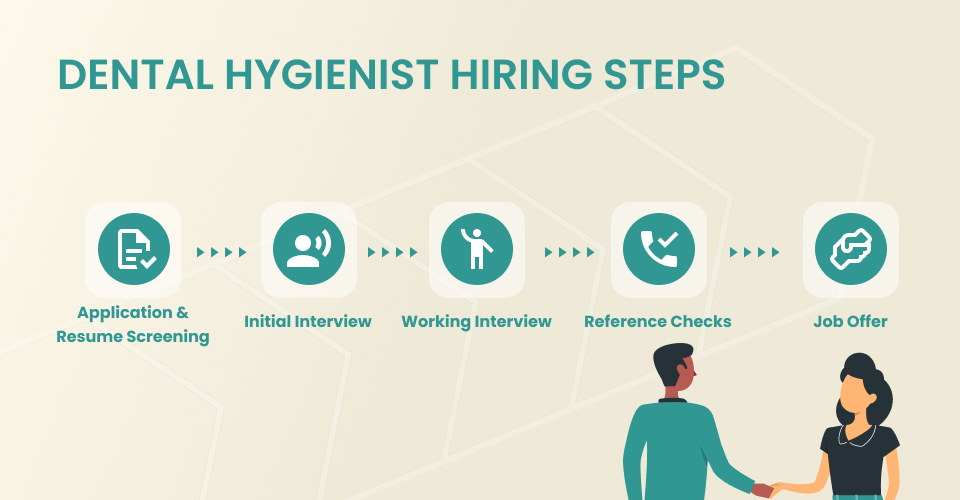
The hiring process for dental hygienists generally follows these steps:
-
Application and Resume Screening:
Employers review your qualifications, experience, and availability. -
Initial Interview:
This may be conducted via phone, video, or in person. Depending on the practice, there may be a follow-up discussion to dive deeper into your experience before moving to the working interview. -
Working Interview (or Shadowing):
A key step for many dental roles, especially hygienists. This is your chance to show your skills in action. -
Reference Checks:
Common in corporate dentistry but less frequent in small private practices. -
Job Offer:
The final formal agreement on compensation and start date.
Most candidates can expect up to three rounds in total: an initial interview (phone, video, or in-person), a follow-up in-person interview if needed, and a working interview. In some cases, particularly for experienced candidates, employers may move directly to a working interview after a brief screening conversation.
The overall timeline can vary widely, depending on practice and role. At the fastest end of the spectrum, you might move from application to start date within three weeks. However, a more typical hiring process for a dental hygienist would take between one and two months. Keep in mind, the timeline may be influenced by factors such as scheduling availability or the number of candidates under consideration.
How many jobs does a candidate typically apply to?
Based on Jobley’s March 2026 data, most dental hygienists apply to one to two nearby facilities that perfectly match their commute and shift preferences. With the support of Jobley’s CS team, candidates typically apply to three to four positions simultaneously to increase their chances of a timely offer.
Why Candidates Get Rejected
Rejection does not always mean a candidate is unqualified. Understanding why candidates get rejected can help you avoid common pitfalls and better prepare for each stage.
During the Initial Interview:
- Availability and Distance: Shift mismatches or a commute that is too long are the primary reasons for rejection.
- Qualifications: Not meeting the specific license requirements or experience level needed for the role will quickly rule you out of consideration.
During the Working Interview:
- Clinical Skill Gap: Failing to meet the dentist’s specific expectations for speed or technique. Since each practice operates differently, expectations can vary.
- Culture Fit: Struggling to adapt to the team’s working style or failing to demonstrate a collaborative and proactive attitude can lead to employers determining you’re not the right fit.
Professionalism and Final Impressions:
- Interview No-Shows and Last-Minute Cancellations: Failing to show up or canceling without notice is the most common reason for immediate rejection. In a close-knit dental community, this can also damage your reputation with future employers.
- Poor Follow-Up and Preparation: Candidates are often passed over if they seem unprepared or fail to show genuine interest in the practice. Small gestures—like researching the office’s values beforehand and sending a brief “thank you” email within 24 hours—help show that you are genuinely invested in the role.
Landing Your Perfect Role
A successful dental hygienist interview is about more than just demonstrating your clinical skills. It’s about showing the person behind the license. Your success depends on your ability to communicate your values, show how you adapt to new environments, and present yourself as a reliable partner in patient care.
With the right preparation, you can approach each stage with confidence and find a practice where you will truly thrive. By reading this article, you’ve already set yourself on the right track. Now, it’s a matter of finding, applying to and connecting with an employer where your career can continue to grow.
Start your search with Jobley and find the opportunity that’s meant for you.